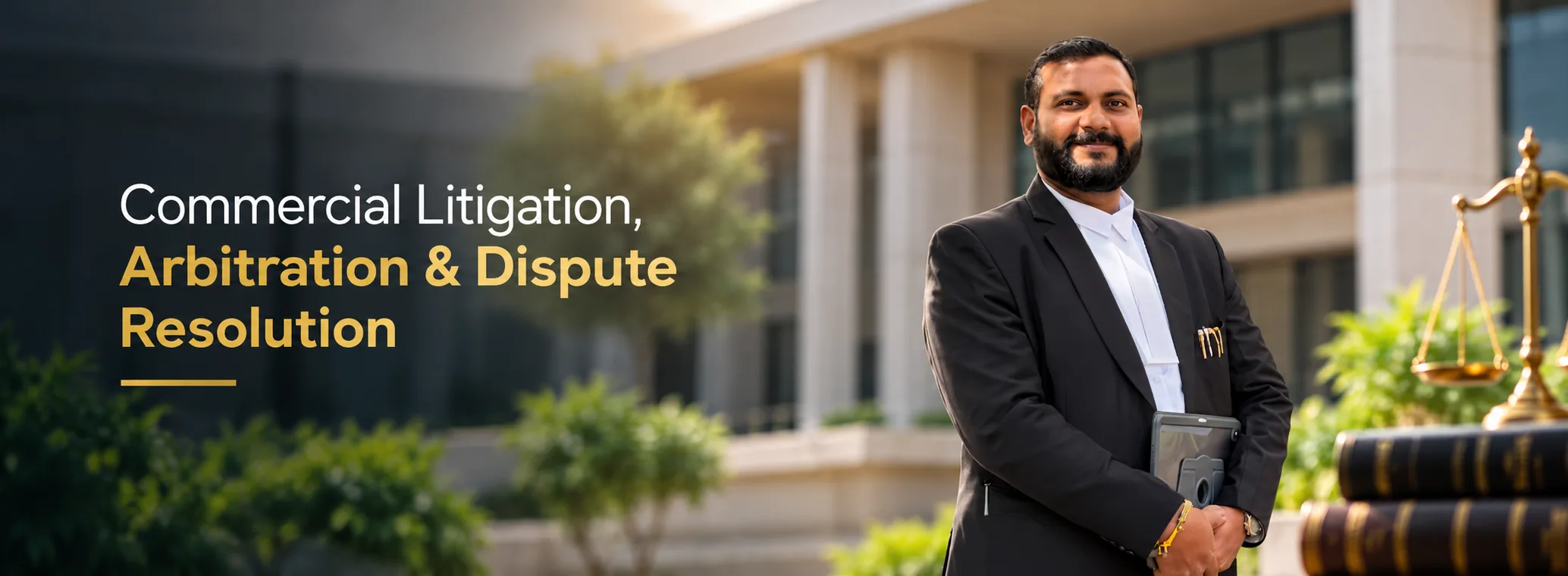
In short. Advocate B.K. Singh is a Delhi NCR advocate with more than twenty years in practice and degrees in computer applications (MCA) and law (LL.B., LL.M.). He handles civil, criminal, commercial, corporate, insolvency, banking, consumer, family, service and environmental matters, from trial courts and tribunals up to the Supreme Court, and leads the strategy and arguments in the firm's litigation.
He founded the firm and still reads every new litigation file himself. Day to day he works with Advocate Sadhna Singh, the partner, who is usually your first contact and runs the file between hearings; her profile is on the Advocate Sadhna Singh page. A directory of both advocates and the associate counsel the firm works with is on Our Associates.
What follows is information, not an advertisement. The Bar Council of India rules do not allow advocates to solicit work or publicise results, so you will not find case wins, client names or claims of rank here. You will find what he studied, where he appears, the kinds of matters he takes on and how he approaches them.
- Role
- Founder and principal advocate
- Qualifications
- MCA, LL.B., LL.M.
- Experience
- More than twenty years in practice
- Courts
- Supreme Court, Delhi High Court, other High Courts, Delhi NCR district courts
- Tribunals
- NCLT, NCLAT, DRT, DRAT, NCDRC, NGT, CAT
- Offices
- Dwarka, New Delhi and Vaishali, Ghaziabad
Who is Advocate B.K. Singh?
Advocate B.K. Singh, whose full name is Bagesh Kumar Singh, is a Delhi NCR advocate who founded B.K. Singh & Associates and leads its litigation. Over more than twenty years in practice he has worked across civil, criminal and tribunal matters rather than in one narrow field, and that shapes how he looks at a dispute. A cheque bounce case may also be a recovery suit. A family dispute may carry a criminal complaint. A bank's possession notice may be better fought in the DRT than in a writ court.
He sees clients at the firm's offices in Dwarka and Vaishali, and by video call. In most matters he is the advocate who argues in court, while drafting and day-to-day management are shared with Advocate Sadhna Singh.
What are Advocate B.K. Singh's qualifications?
He holds three degrees: an MCA (Master of Computer Applications), an LL.B. and an LL.M. The LL.B. is the law degree that qualifies a person for enrolment as an advocate; the LL.M. is a postgraduate law degree that adds depth in legal research and doctrine. The MCA came before law and is the less common part of his background.
Like every practising advocate, he is enrolled with a State Bar Council under the Advocates Act 1961. His enrolment details are printed on every vakalatnama he signs, and you are welcome to ask for them at the first meeting. We do not list honours, rankings or memberships on this page. The Bar Council rules discourage it, and such lists tell you little about how a lawyer will handle your case.
How does a computer science background help in legal work?
It helps most where the evidence is digital, which now means most cases. Under section 63 of the Bharatiya Sakshya Adhiniyam 2023 (earlier section 65B of the Evidence Act), an electronic record needs a proper certificate before a court will rely on it. Disputes about who made a WhatsApp export, whether a CCTV clip was edited or how a server log was generated are increasingly where cases turn. An advocate who understands hash values, metadata and how data is stored can ask sharper questions of an investigating officer or a forensic report.
The same background helps in cyber crime cases under the IT Act 2000 and the BNS, in disputes over software development and licensing contracts, and in data protection questions under the Digital Personal Data Protection Act 2023. It does not make him a forensic examiner, and where a technical report is needed we engage one. It does mean the technical evidence gets read properly. More on this work is on the cyber laws and cyber crime lawyer pages.
Which courts and tribunals does Advocate B.K. Singh appear in?
He appears regularly in the courts and tribunals of Delhi NCR and, with Advocates-on-Record or local counsel where the rules or logistics require, in the Supreme Court and other High Courts.
| Court or tribunal | Typical matters | Note |
|---|---|---|
| Supreme Court of India | SLPs under Article 136, writs under Article 32, transfer petitions, review petitions | Filed through an Advocate-on-Record; he prepares and argues |
| Delhi High Court | Bail, quashing under BNSS s.528, writs, civil suits above ₹2 crore, arbitration petitions | Original and appellate side |
| Other High Courts | Appeals and revisions from Noida, Ghaziabad, Gurugram and other districts | With local counsel for routine dates |
| Delhi district courts | Criminal trials, bail, civil suits, family cases, cheque bounce | Tis Hazari, Saket, Patiala House, Karkardooma, Rohini, Dwarka, Rouse Avenue |
| Noida and Ghaziabad courts | Criminal, civil and family matters | Gautam Buddh Nagar court at Surajpur; Ghaziabad district court |
| NCLT and NCLAT | IBC petitions, oppression and mismanagement | New Delhi benches |
| DRT and DRAT | SARFAESI section 17 applications, recovery OAs, appeals | Pre-deposit rules apply in appeals |
| Consumer commissions | District, State Commission and NCDRC complaints and appeals | Builder, insurance, bank and service cases |
| NGT and CAT | Environmental applications and appeals; service matters of Central Government employees | Principal Benches in New Delhi |
What kinds of cases does he handle?
His practice is broad: civil, criminal, commercial, corporate, insolvency, banking, consumer, family, service and environmental matters. In practice the work gathers around a few kinds of problem. Criminal matters include bail, anticipatory bail, quashing, trials and cases investigated by the ED, CBI, SFIO and NCB. Commercial and corporate work includes recovery suits, commercial court cases, arbitration petitions and NCLT matters under the Insolvency and Bankruptcy Code. Banking work is largely for borrowers and guarantors facing SARFAESI action or DRT recovery.
He also takes family disputes that have turned litigious on several fronts at once, service matters before the CAT, and environmental applications before the NGT. The full list of practice areas is on the areas of practice page, and criminal work by agency and offence is under criminal law practice.
What does he look at first in a new file?
The first thing he looks for is the date that cannot be missed. A limitation period, the 60 days in a SARFAESI demand notice, the 45-day limit for a securitisation application under section 17, the 90 days for a special leave petition, or simply the next date in a pending case: until that is known, nothing else gets planned.
After that he reads the other side's documents before your version of events. The FIR, the complaint, the plaint, the bank's notice or the show cause notice tells him what has to be answered, and often shows a gap a client would not notice: a wrong section, a missing sanction, a notice served at an old address, an electronic record without a certificate. Only then does he ask you to fill in what the papers do not say.
How does Advocate B.K. Singh approach a case?
He tries to answer three questions early and to give you the answers plainly: what is the best realistic outcome, what is the worst, and what will it take in time and money to get from here to either. Clients sometimes want only the first answer. He gives all three, because a decision to fight, settle or wait should be made with the whole picture in front of you.
He also prefers fewer, better-drafted filings to many applications. A bail application that deals squarely with the prosecution's strongest point, or a written statement that sets up the real defence in the first round, usually does more than a string of interim applications. Where a case can be settled, through mediation, a Lok Adalat or a negotiated compromise, he will say so even when the client arrives angry.
What he will not do is promise a result or a date. Bail, quashing, a stay or a final judgment depends on the court, the facts and the law as it stands that day, and timelines depend on the court's board, judicial vacancies and the conduct of the other side. What he can commit to is the work: that the papers are read, the deadlines met, the arguments prepared and the advice given straight. If anyone promises you a certain result in a court case, treat it as a warning sign rather than a comfort.
Will he tell me if I should not go to court?
Yes, and that conversation is part of the first meeting. Some disputes are better resolved by a well-drafted legal notice and a meeting. Some cheque cases are worth less than the time they will take. Some service grievances must first go through the departmental remedies required by section 20 of the Administrative Tribunals Act before the CAT will hear them. Some bank and insurance complaints are better taken to an ombudsman.
He will also tell you if the other side has the stronger case. That is uncomfortable to hear, but it is useful: it lets you negotiate from a realistic position instead of spending two years discovering the same thing in court.
How does a matter with Advocate B.K. Singh usually proceed?
The sequence differs from case to case, but most matters go through these stages.
First reading
You send the papers, usually through Advocate Sadhna Singh. He reads them, notes the deadline and any obvious weakness on either side, and decides what more is needed before advice can be given.
Meeting and advice
At the first meeting he explains the options, the realistic outcomes and the likely stages. Fees are discussed and then agreed in writing, stage by stage; court fees and out-of-pocket costs are separate.
Drafting
The petition, application, reply or notice is drafted, usually with Advocate Sadhna Singh preparing the first version and him settling it. You check the facts before anything is filed.
Filing and hearings
The matter is filed, listed and argued. He appears at the hearings that matter, and you are told after every date what happened and what the next date is for.
Review at each stage
After an interim order, a chargesheet or the close of evidence, the strategy is reviewed with you. Settlement, appeal or a change of course is discussed openly rather than assumed.
How does he work with Advocate Sadhna Singh?
The two advocates split the work by what each does best and by what the case needs that week. Advocate Sadhna Singh is usually the first to speak to a client; she collects and reads the papers, prepares the first drafts and keeps the file moving through filing, listing, compliance and updates. Advocate B.K. Singh sets the strategy, settles the drafts and argues.
Because both know the file, you are not left waiting when one of them is in court. How the firm runs a matter internally, including research and clerical support, is explained on the Our Team page.
Does he handle Supreme Court cases?
Yes. He prepares and argues special leave petitions under Article 136, writ petitions under Article 32, transfer petitions (common in matrimonial cases, to move a case from one state to another) and review petitions. Filing in the Supreme Court is done through an Advocate-on-Record, as the Supreme Court Rules 2013 require. He works with an AOR who files and is on record, while he settles the paper book and argues.
In Supreme Court work the deadline is usually the first problem. A special leave petition against a High Court judgment should be filed within 90 days, and the certified copy, translations and paper book all take time. If you are thinking about an SLP, come in well before the period runs out. The Supreme Court lawyer in Delhi page explains the filing process.
Does he take criminal cases and bail matters?
Criminal work is a large part of his practice. He handles bail and anticipatory bail under sections 480, 482 and 483 of the Bharatiya Nagarik Suraksha Sanhita 2023, quashing petitions in the Delhi High Court under section 528, trials in the Sessions Courts and magistrates' courts, and cases investigated by central agencies, where special statutes such as the PMLA, NDPS Act and UAPA make bail much harder to get.
Since 1 July 2024 the BNS, BNSS and BSA have replaced the IPC, CrPC and Evidence Act, while cases registered before that date mostly continue under the old law. Getting that right in the first application matters more than people think. Bail is covered in detail on the bail lawyer page.
What about tribunal work: NCLT, DRT, NGT and CAT?
Tribunals have their own rules and timelines, and missing one can end a case before it starts. Before the NCLT he acts in petitions under the Insolvency and Bankruptcy Code and in oppression and mismanagement cases under sections 241 and 242 of the Companies Act 2013. Before the DRT he acts mainly for borrowers and guarantors, including applications under section 17 of the SARFAESI Act, which must be filed within 45 days of the measure taken by the bank.
Before the NGT he handles applications and appeals under the National Green Tribunal Act 2010, and before the Central Administrative Tribunal, service matters of Central Government employees, from disciplinary penalties to pension and promotion. An appeal from the DRT to the DRAT needs a pre-deposit, and he will tell you early what that means in money. For company matters see NCLT lawyer in Delhi; for bank cases, DRT lawyer in Delhi.
Does he handle commercial disputes and arbitration?
Yes. Commercial disputes of a specified value of ₹3 lakh and above fall under the Commercial Courts Act 2015, which brings strict rules: pre-institution mediation under section 12A before a suit is filed, unless urgent interim relief is needed, and a written statement that cannot be filed later than 120 days. He spends time at the start making sure the plaint or the defence is complete, because these courts do not forgive a thin first filing.
In arbitration he acts in petitions under the Arbitration and Conciliation Act 1996: interim protection from the court under section 9, appointment of an arbitrator under section 11, challenges to awards under section 34 (three months, plus up to 30 days for sufficient cause) and enforcement under section 36. He also appears before arbitral tribunals. Where the contract has an arbitration clause, he will usually advise you to use it rather than file a suit that the other side will ask the court to refer under section 8.
Does he act for complainants as well as the accused?
Yes. In criminal matters he acts for people accused of offences and for people who have been wronged and want the law to act: a complainant in a cheating or criminal breach of trust case, a victim of online fraud, a cheque holder under section 138 of the Negotiable Instruments Act. The work is different on each side. For a complainant, the effort goes into a complaint that states the offence clearly and attaches the documents, and into pressing for proper investigation when the police are slow.
When the police do not register an FIR for a cognizable offence, the remedy under the BNSS is to approach the Superintendent or Deputy Commissioner of Police, and then the magistrate under section 175(3). For offences punishable with three to seven years, the police may first hold a preliminary enquiry of up to 14 days under section 173(3). He explains which route fits before you file, so the complaint is not lost in the wrong office.
Does he act in consumer cases?
He does, mostly in the larger and more contested ones. Advocate Sadhna Singh handles many consumer complaints at the District Commission level, and he appears where the claim goes to the State Commission (above ₹50 lakh and up to ₹2 crore) or the NCDRC (above ₹2 crore), and in appeals. Builder delay, insurance repudiation, bank service failures and medical negligence are the usual subjects.
In builder cases he will also explain the choice between a consumer complaint and a complaint to the RERA authority, because a homebuyer can choose either, and the better forum depends on the relief you want and how far the project has gone. The wider picture is on the consumer and competition laws page.
What mistakes does he see most often before a client comes in?
Many cases are harder than they need to be because of something done, or not done, in the first few days. These are the ones he sees again and again.
- Waiting for the second notice. People ignore a summons, a demand notice or a show cause notice, hoping it will go away. Deadlines start running from the first one.
- Replying without advice. An angry reply to a legal notice, or a WhatsApp message admitting part of a debt, often becomes the other side's best evidence.
- Giving away originals. Original agreements, cheques and title papers are handed to a broker, a police officer or the other side without keeping a copy or a receipt.
- Going to the police station alone. Answering questions in an inquiry without knowing what the complaint says, or signing a statement without reading it.
- Deleting chats and data. Clearing a phone or an email account, sometimes in panic, sometimes to tidy up, destroys evidence that may have helped and can look like concealment.
- Filing in the wrong forum. A complaint before the wrong court or tribunal, or a suit where the contract required arbitration, costs months before the case reaches the right place.
What is it like to work with him as a client?
Expect him to be direct. He will ask for documents before opinions, interrupt a long story to ask for a date, and tell you what he thinks of your case even if it is not what you hoped to hear. He explains the law in plain words, and if you do not follow, he explains it again.
He is in court for much of the day, so calls are often returned after court hours, and routine questions are usually answered by Advocate Sadhna Singh, who knows the file just as well. Before each important hearing he will want a short conversation with you to check the facts he intends to rely on. Come to that conversation with your papers in hand.
A made-up example: an electronic record that was never certified
Here's a made-up example. A shop owner in Dwarka is accused of sending threatening messages to a former business partner. The chargesheet relies on screenshots of WhatsApp messages produced by the complainant, with no certificate under section 63 of the Bharatiya Sakshya Adhiniyam and no seizure of the complainant's phone.
Reading the chargesheet, Advocate B.K. Singh notes that the screenshots do not show the phone numbers clearly, that the messages are dated after the partnership dispute reached a civil court, and that the investigating officer never asked the service provider for records. None of this decides the case on its own. But it tells him where to focus at the stage of framing of charge and in cross-examination, and it gives the client a realistic sense of the case against him, instead of either panic or false comfort.
Has he written or published on the law?
He writes and reviews plain-language explanations of the law for the firm's websites, including the pages on this site, and prepares notes for clients on procedure in particular courts and tribunals. We describe this only in general terms, because the purpose of this website is information, not self-promotion.
If you want to know whether he has dealt with a particular kind of matter before, ask at the first meeting. He will answer honestly, without naming other clients, and tell you if the matter would be better handled with, or by, someone else.
What to send before a meeting with Advocate B.K. Singh
He reads the papers before he meets a client. Sending them in advance, even as clear phone photos, makes the first meeting far more useful.
Criminal matters
- FIR copy or complaint
- Any notice under BNSS s.35 or summons
- Bail orders and order sheets so far
- Chargesheet, if filed
- Names of the police station and the court
Civil, commercial and bank matters
- Agreement, invoices and ledger
- Legal notice and reply
- Plaint, written statement or the bank's notice
- SARFAESI notices under s.13(2) and s.13(4)
- Last order and next date
Supreme Court and High Court
- Impugned judgment and its certified copy
- Trial court record or key documents
- Date of the judgment and of the certified copy
- Any earlier petitions in the same matter
Tribunal and service matters
- Show cause notice, charge sheet or penalty order
- Representation made and any reply
- Service record extracts
- NCLT, DRT or NGT filings so far
How can I meet Advocate B.K. Singh?
Meetings are by appointment at the Dwarka or Vaishali office, or by video call. The usual route is to send a short note and the key papers through the online enquiry or on WhatsApp; Advocate Sadhna Singh will read them, ask for anything missing and fix a time. Urgent matters, such as an arrest, an agency summons or a hearing the next day, are passed to him the same day.
Directions to both offices and how video consultations work are on the offices page. Fees are discussed at the first meeting and then agreed in writing, stage by stage.
Frequently asked questions
Who is Advocate B.K. Singh?
Advocate B.K. Singh (Bagesh Kumar Singh) is the founder and principal advocate of B.K. Singh & Associates, with offices in Dwarka, New Delhi and Vaishali, Ghaziabad. He has more than twenty years in practice, holds an MCA, LL.B. and LL.M., and appears before the Supreme Court, High Courts, district courts and tribunals.
What are Bagesh Kumar Singh's qualifications?
He holds a Master of Computer Applications (MCA), a Bachelor of Laws (LL.B.) and a Master of Laws (LL.M.). The LL.B. qualifies him for enrolment as an advocate, the LL.M. is a postgraduate law degree, and the MCA gives him a working knowledge of computers and data that helps in cyber and electronic evidence cases.
How many years has Advocate B.K. Singh been practising?
More than twenty years. Over that time he has worked in civil, criminal, commercial and tribunal matters across Delhi NCR, and in the Supreme Court and other High Courts with Advocates-on-Record and local counsel where needed. His enrolment details appear on the vakalatnama and are available on request.
Does Advocate B.K. Singh appear in the Delhi High Court?
Yes. He appears in the Delhi High Court in bail applications, quashing petitions under BNSS section 528, writ petitions, civil and commercial matters and arbitration petitions. The High Court's original civil jurisdiction covers suits valued above ₹2 crore; smaller suits go to the district courts, where he also appears.
Can Advocate B.K. Singh file my case in the Supreme Court?
He prepares and argues Supreme Court matters, and the filing is done through an Advocate-on-Record, because the Supreme Court Rules 2013 permit only an AOR to file. You are told who the AOR is, and the fee arrangement is put in writing before the petition is filed.
Does he handle cyber crime cases?
Yes, for both complainants and accused. His MCA background helps with the technical side: electronic records, metadata, call detail records and the section 63 BSA certificate. Victims of online fraud should report to the 1930 helpline or cybercrime.gov.in quickly, because early reporting improves the chance of freezing the money.
Will I meet Advocate B.K. Singh himself or a junior?
You meet him. There are only two advocates at the firm. Advocate Sadhna Singh is often the first contact and arranges the meeting, but advice on litigation he leads comes from him, and he appears in the hearings that matter.
Does Advocate B.K. Singh take family and divorce cases?
Yes, particularly where a family dispute has turned into several cases at once, such as a divorce petition, a maintenance case, a domestic violence complaint and a criminal case under BNS sections 85 and 86. Many family matters are run day to day by Advocate Sadhna Singh, with him appearing in contested hearings.
What is his approach to settlement?
He raises it early where it makes sense. Court mediation centres, Lok Adalats and negotiated settlements resolve many cheque bounce, family and commercial disputes faster and more cheaply than a trial. He still prepares the case fully, because a settlement is negotiated better when the other side knows you are ready to argue.
Does he handle DRT and SARFAESI matters?
Yes, mostly for borrowers and guarantors. A securitisation application under section 17 of the SARFAESI Act must be filed in the DRT within 45 days of the bank's measure, such as taking possession. An appeal to the DRAT needs a pre-deposit of 50% of the amount, which the DRAT can reduce to 25%.
Does Advocate B.K. Singh appear in the NCLT?
Yes, before the NCLT New Delhi benches and the NCLAT, in insolvency petitions under sections 7, 9 and 10 of the IBC, in matters involving personal guarantors, and in oppression and mismanagement petitions under the Companies Act. An appeal to the NCLAT must be filed within 30 days, extendable by 15 days.
What does Advocate B.K. Singh charge?
Fees are not quoted on the website, in line with the Bar Council rules. They are discussed at the first meeting and agreed in writing, stage by stage, depending on the court and the work involved. Court fees and other out-of-pocket costs are separate.
Does he take matters outside Delhi?
Yes, in many cases. Matters in Noida and Ghaziabad are handled directly. For other High Courts and district courts, he prepares and argues the substantive hearings while local counsel attends routine dates, so that you are not paying for travel on every adjournment.
Does he handle service matters before the CAT?
Yes. Central Government employees challenging a penalty, a promotion decision, seniority, pay fixation or pension go to the Central Administrative Tribunal under section 19 of the Administrative Tribunals Act 1985. The application should usually be filed within one year, after using the available departmental remedies, and CAT orders are challenged in the High Court.
Does he appear before the National Green Tribunal?
Yes, at the NGT Principal Bench in New Delhi. Time limits are strict: six months for applications under section 14, five years for compensation under section 15 and thirty days for appeals under section 16, each with up to sixty days more for sufficient cause. Appeals from the NGT go to the Supreme Court within 90 days.
Can he help with an ED or CBI summons?
Yes. An ED summons under section 50 of the PMLA or a CBI notice needs preparation before the appearance, including which documents to carry and whether protection from arrest should be sought. Bring the summons and any earlier statements; the date on the summons decides how fast we need to move.
How quickly will he respond to an urgent matter?
Urgent matters, such as an arrest, a raid, an agency summons or a hearing the next day, are passed to him the same day they reach the firm. Calling or sending the FIR, summons or order on WhatsApp is faster than the online form. No one can promise that a court will hear a matter on a particular day.
Does he give legal opinions in writing?
Yes. Written opinions are given on questions such as the strength of a claim, title to property, the effect of a contract clause or the exposure in a criminal complaint. The opinion states the documents relied on and the assumptions made, and the fee for it is agreed in writing beforehand.
Has Advocate B.K. Singh won cases like mine?
The Bar Council of India rules do not allow advocates to publicise results, so we do not list outcomes. At the first meeting he will tell you whether he has handled similar matters, without naming other clients, and give you a realistic view of your own case on its facts.
How do I book an appointment with Advocate B.K. Singh?
Send a short note and the key papers through the online enquiry or on WhatsApp. Advocate Sadhna Singh will read them, ask for anything missing and fix a meeting at the Dwarka or Vaishali office or by video call.